




In the context of professional construction, where deadlines are tight and margins for error are small, maintaining material consistency is crucial. This promotes increased longevity of the material and, as a result, impacts profitability. To this end, there are few tools more useful than the concrete mixer.
Beyond just a drum on wheels, it acts as a hub for any structural project and transforms raw aggregate materials and binders into a homogeneous, robust material. This is the literal foundation of any successful infrastructure. For the modern builder, focusing on securing future profitability relies largely on selecting the correct equipment for maximum output. Other factors which are emphasised are little downtime and consistent quality.
The following article will discuss the strategic decisions involved in choosing the best mixer for calculating capacity to scale, understanding different power unit options and sufficiently mastering the operational practices that ensure the best return on investment for your construction needs.
Matching The Mixer To The Mission: Capacity And Project Scalability
When deciding on which concrete mixer to buy, the first thing to consider is what capacity or desired output is required for your construction project. Further, determining the size of the mixing drum largely dictates how much concrete is going to be produced in a single batch. This, in turn, determines the efficiency of the subsequent workflow. Thus, if you are a construction professional and focused on the task of continuous and high-volume output, it is important to recognise the difference between available capacities.
BS Power manufactures a robust range of professional-grade units which vary in scale, from sizes starting at 36 L through to 400L, 420L and finally, 500L capacity drums. With this wide selection, various project needs can be addressed.
With the mid-range professional mixers with a capacity between 360L and 420L, this is ideal for the use of commercial contractors who handle small to mid-sized jobs. This can extend from residential foundations to extensive paving projects. In instances where the work sites are larger and mobility is key; this drum mixer capacity is a good solution. Thus, offering an excellent balance between mobility and ease of relocation while being able to maintain a steady flow of material output, this mixer is the ultimate hack for increasing on-site efficiency.
The 500L high-volume commercial mixers, on the other hand, are perfect for working on larger projects such as commercial buildings, bridge components and large-scale civil infrastructure. Naturally, its ability to generate large output means that it will be able to meet large-volume demands, thereby maximising throughput. Through the ability to save time in the direct mixing process, labour costs are reduced, and faster project completion is attainable.
Therefore, this initial higher investment option pays for itself when considering operational efficiency. The most crucial factor for project managers to consider is for project managers was to calculate pour volume and match it against mixer output as well as loading and discharge times.
Overestimating required capacity is generally the preferred course of action rather than underestimating capacity, as this can easily be a big derailer on scheduling, as wait time is increased while the next batch of concrete is mixed. To account for this increase in capacity, the use of a larger drum, when used efficiently, ensures that the placement crew is fully utilised, thus mitigating frustrating bottlenecks at a core production level.
Understanding What Lies At The Heart Of The Machine: Strategic Engine Selection For Power And Longevity
Typically, petrol or diesel concrete mixers operating within the DIY or professional realm use this fuel to drive a heavy drum in order to handle high torque demands from mixing dense and viscous materials. Relying on the dependable Baumax engine and the globally recognised Honda engine, BS Power provides only the best concrete mixers. The choice of engine goes beyond mere brand loyalty; it is a considered decision in investing in power, fuel efficiency and sustainable long-term maintenance cycles.
Serving the primary role in the production of concrete, the engine ensures continuous drum rotation no matter the weight/load. If you do not have a sufficiently powerful engine, you run the risk of unnecessary strain, overheating or complete seizing of the engine. This can lead to extremely costly and inconvenient downtime.

Demystifying The Power Equation: Reliability Vs. Initial Cost
Opting to use engines from established global manufacturers like Honda means that you are choosing proven durability and consistent power delivery. Choosing a very well-known brand like Honda also provides you with the added benefit that you will always have an extensive support network at your disposal.
These engines are renowned for their reliability across different environmental conditions and are engineered for long service intervals, which can operate throughout continuous use. Pros include a very low likelihood of unexpected failures, whilst a con is that it carries a higher upfront cost.
Alternatively, with a specialist engine like the Baumax, this engine is designed so that it can provide the necessary performance required in a construction environment while entering the market at a more economical price point. If it is selected from a reputable dealer like BS Power, where high manufacturing standards are upheld, this engine offers a powerful and cost-effective alternative to the more well-known brands like Honda. The biggest advantage here is that while it comes in at a lower price point, it does not compromise its ability to perform well under heavy-duty loads.
Yet no matter which brand you decide to go with, the longevity of this power unit will depend on adherence to rigorous maintenance protocols. This includes regularly checking engine oil and air filters. This is specifically important for dusty construction environments. Other aspects to keep an eye on include spark plugs for the petrol models. When ignoring routine maintenance, you risk the chance of component failure.
Thus, construction professionals should do their best to treat their mixer engine with careful and preventative care. For further detailed guidance on protecting heavy-duty equipment, consulting specific resources that outline the importance of best protecting your engine maintenance of construction machinery is advisable: The Ultimate Guide to Construction Equipment Maintenance.
Beyond the concrete mixer’s engine, its perceived lifespan is determined by other factors such as the structural integrity of its frame, as well as the quality of its drive system. This is because the construction environment is often unpredictable and characterised by rough handling, uneven terrain and constant vibration, which stresses out and breaks down weak machinery.
Robust Build Quality
For ultimate longevity, a professional-grade mixer needs to be built on a heavy-duty, reinforced chassis. For this, key indicators of durability include the steel gauge, welding quality, the axle and wheel system.
The Steel Gauge: for the steel material of the gauge used for the drum, its paddles and the frame should be thick enough that they can withstand the abrasive action of aggregates and be able to handle the repeated impact of loading and discharging the materials.
Welding Quality: for continuous seam welds, which maintain high quality so as not have intermittent spot welds, the frame needs to retain rigidity and be capable of absorbing constant torque.
Axle and Wheel System: for units which require mobility, a robust axle and heavy-duty, wide-stance pneumatic wheels are an essential factor in the safe towing and stability of the operation in conditions where the ground is soft or uneven.
Optimisation Of The Mixing Action
The majority of professional mixers utilise a rotating drum design with in-built mixing paddles. Due to the geometry of the drum and angle of the paddles, operationality is optimised to ensure an even mix. This results in the cement, aggregates and water being evenly distributed throughout the concrete.
For the mixing action, it is important to focus on the tilting mechanism so that it is smooth and reliable; generally, these are either worm-driven or geared. Units which are designed for larger batches should also strategically consider the discharge points to accurately calculate a rapid and controlled pour. This can then be poured directly into concrete pumps, wheelbarrows and skip loaders, which reduces spillage and labour intensity.
The drive system is what determines how power is transmitted from the engine to the drum. For robust mixers which have heavy-duty gearboxes or chain-drive systems, these are ordinarily protected by sturdy guards.
This, in turn, can handle instantaneous load changes that occur when the mixing process occurs or when coarse aggregates shift around inside the drum. A good drive system will thus ensure years of trouble-free operations for construction projects.
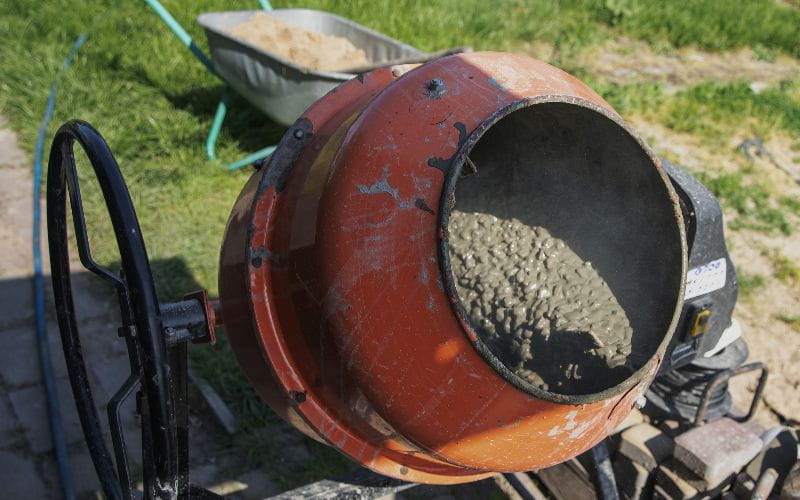
The Importance Of The Water-Cement Ratio
The water-cement ratio or W/C has a direct impact on the compressive strength and durability of hardened concrete. This ratio is determined by dividing the weight of the cement by the weight of the water. For concrete, which is high strength, extremely durable and low on porosity, a low W/C is preferred. The tricky side to this, however, is that the resultant product is very stiff and requires a specifically powerful mixer to blend the components thoroughly.
Alternatively, a high W/C results in an easy-to-pour mix allowing for a workable consistency. This, however, does mean less strength and high porosity, which could lead to voids as the water evaporates. The larger capacity units offered by BS Power allow for a powerful and well-balanced concrete mixer with a robust engine and streamlined drum design. This ensures the necessary mechanical energy required to mix and homogenise a more even and high-strength mix, which would ordinarily stall a weaker machine.
Having this as a capability is particularly important in making sure that the material used for structural designs is up to the task of remaining firm against changing environmental conditions, such as carbonation or chemical ingress. In order to understand how small deviations could potentially impact long-term structural performance, take a look at the following article, which outlines this golden ratio: Water-Cement Ratio: The Secret to Stronger Concrete.
Achieving Perfect Consistency With The Mixing Master
In conclusion, the effectiveness of a concrete mixer extends far beyond simply combining materials; it is essential for achieving the precise standards required in modern construction. By ensuring a consistent mix with an optimal water-cement ratio and robust mechanical action, a quality mixer guarantees both workability and strength in the final product. This not only safeguards the structural performance and durability of concrete but also supports the efficiency and reliability of construction operations.
Ultimately, investing in a high-quality mixer is an investment in the long-term success and resilience of any building project. Ready to elevate your construction results? Explore our range of advanced concrete mixers today and experience the difference that precision, and reliability can make for your next project.