





Concrete mixers are considered the easiest way for your team to continue working on time efficiently without much extra effort. If in the past you had to wait for a batch of concrete to become ready or saw the work speed drop to a crawl because your mixing method could not keep up with your team, you have no doubt seen the difference that having the right equipment can make. This piece discusses ways for concrete or cement mixers to assist you in avoiding the kinds of time-wasting situations that can have a serious impact on both your schedule and your budget.
Why Concrete Mixers Matter For Project Timelines
When you are running a build, laying a driveway, pouring a foundation, or building a boundary wall, timing is crucial. Once the water hits the cement, concrete starts to harden, so every minute you spend mixing by hand, or sitting waiting for a sluggish mixer, is a minute working against you. That is where concrete or cement mixers come in, supplying you with a tight, mechanically driven mix on demand, in the right quantity, time after time. When you work on anything larger than a patch, you will quickly discover that hand-mixed methods cannot hold a candle to machine mixing with a concrete mixer. Hand mixing is more labour-intensive, more unpredictable, and slower, taking your construction workers’ attention away from other tasks on site.
The increased speed and efficiency of concrete mixers allow your workers to concentrate on formwork, reinforcement, and finishing, while the auto mixer takes care of the mixing chores. This is where the strength of the auto mixer is revealed. Not in making the whole mixing process faster, but in allowing your whole crew to work in parallel instead of in sequence. That alone can save hours on a frantic pour day.
Common Causes Of Delay In Concrete Work
Let us develop a better understanding of how concrete or cement mixers tackle delays before jumping to that conclusion. One of the most common reasons for delays is ineffective batching. If the batching process is not consistent in its ratios, then the strength and workability of the concrete are not consistent from batch to batch. This leads to additional work or delays due to the need to repair a previously placed section of concrete or wait for a correction to be added to the mix. Quality mixers with the ability to maintain a constant drum speed to produce consistent batches can really reduce the number of delays during the daily operation of a project.
Others are equipment breakdowns, which are also significant causes of lost time. Placing mixers under the strain of an everyday construction site causes them to break down at the most inopportune time, like during a pour, when you have no room to stop that pour and empty the tank. This is why the build quality of your concrete or cement mixers is just as important as their size. The best mixers, for all their size, should have a heavily reinforced drum and a dependable engine, so that your concrete workers do not have to stand around while the mix in the drum hardens.
Discharge and loading inefficiencies also contribute to delays. Lower discharge heights and loading angles force your operators to spend more time manoeuvring wheelbarrows or moving material by hand. High-performance concrete or cement mixers incorporate practical loading and discharge heights that reflect the reality of South African construction crews. Finally, under-sized mixers are an occasional and usually unnoticed reason for delay.
If your mixer is under-sized for the job, you will be cycling far more than you need to for the same job and paying the price in increased mixing time and fuel or labour costs. Selecting mixers appropriate for the job can easily be the best step you can take to avoid this problem altogether. It pays to do your homework before you even start to lay your concrete rather than during your work, since the use of too-small concrete or cement mixers can be a bit of a pitfall.
Weather and site conditions can also extend a pour, but by choosing the correct mixers, you have more control over the way you respond. The use of a concrete mixer with a dependable engine and a quick cycle time can enable you to work in shorter weather windows and stay ahead of any change in conditions, because you aren’t being impeded by a mixer that can’t keep pace.
How The Right Concrete Mixer Speeds Up Your Workflow
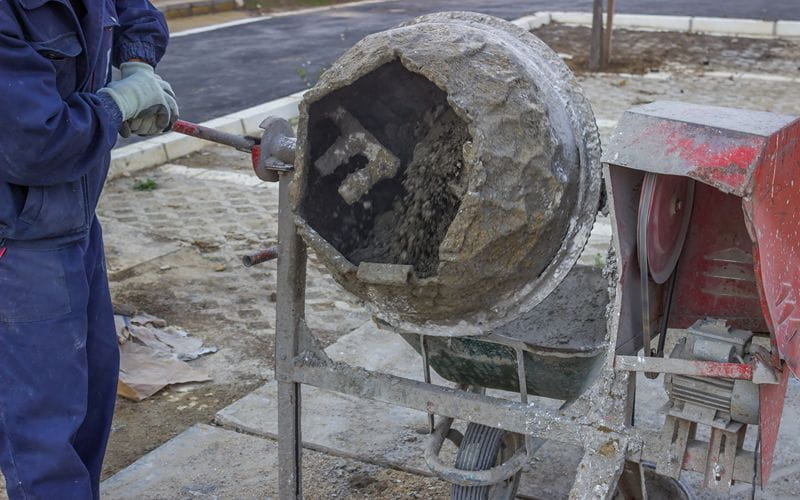
The size and speed of the mixers you use directly affect the rate at which a job progresses. A greater drum volume in concrete or cement mixers means more concrete per batch and fewer stoppages to interrupt your pour, reducing time consumed by reloads. This is mainly beneficial in large foundations, slabs, and structural components where a calm, continuous flow in your mixers results in a more robust and uniform end product. Another factor that definitely affects the productivity of concrete or cement mixers is the drum speed and mix cycle time.
Mixers that are able to mix a given volume of material in a short cycle time will keep a workforce supplied with the fresh concrete in a percentage of time commensurate with their placing rate. This way, no instances of workers waiting for concrete to be produced, or of mixed material sitting too long before being placed, will be encountered. One thing that can save your day is engine reliability when under load.
A solid petrol engine, Honda, or Baumax, in your concrete mixer will keep the drum turning over while you pour batch after batch. It is reliability like that which distinguishes a good concrete mixer: one that saves your day rather than one that works against it. Mobility is also important. A ready-mix concrete mixer with robust wheels enables you to move the machine around the site as your pour goes along, instead of having to transport the (well-mixed) concrete over long distances by hand from stationary mixers. This is a time saver over the course of a working day, mostly on large sites where the pour moves forward as work gets done.
Safety features play a part in speed, though this can be missed. The all-enclosed engine cabin and ring gear cover on your ready-mix mixers keep your operators away from moving components, reducing safety-related downtime and preventing costly effects like reports to insurance companies or lockouts on machinery. Safe concrete mixers are fast ones.
Featured BS Power Mixers Built For Efficiency
At BS Power, we carry several concrete mixers that are aimed at eliminating the delays that hamper the performance of South African construction teams. Two concrete mixers we recommend are the 420L Concrete Mixer with a Baumax engine and the 500L Concrete Mixer with a Honda engine. The 420L concrete mixer with a Baumax engine is a perfect match for owner-builders and rental companies who require a reliable machine for day-to-day use. The Italian-designed frame, robot-welded ring-gear cover and enclosed engine cabin set the Baumax apart from any other concrete or cement mixers, providing complete protection for your operators.
Fitted with a Baumax RX200 6.5 petrol engine and driven by a twin V-belt drive, this mixer features a 420-litre drum, an unmixed capacity of 320 litres and a mixed capacity of 220 litres, all in a two-minute mix-cycle time. With a 25 RPM drum speed and a 3 mm drum thickness, this Baumax’s performance can be relied upon time after time.
Our 500L Concrete Mixer with Honda engine is a superior model we offer to contractors and rental providers who wish to increase their volume while still maintaining an elevated level of dependability. It has the same safety-conscious design as the rest of our cement mixers, with a ring gear cover and enclosed engine compartment and is mounted on a tubular channel iron and folded metal chassis. It has an aggregate capacity of five hundred litres, with an unmixed volume of 420 litres and a mixed volume of 280 litres, powered by a trusty Honda GX160LX at 24 RPM.
Invest In Dependability With BS Power
Typically, a delayed timeline on a project site does not result from a single problem. The mixing stage of construction is the most common place where delays occur. Buying sturdy, highly functional concrete or cement mixers that produce uniform output ensures you get dependable, stable engine performance, allowing you to adapt to changes on the job site. Your project might require the mobility of a 420L Concrete Mixer with a Baumax engine or the high production level of a 500L Concrete Mixer with a Honda engine; BS Power supplies all sorts of mixers on which you can depend. Visit our website to view our collection of mixers or seek advice from our team on the most suitable machine for your next project.