




The strategy behind a new construction project, whether a high-density residential development spanning from Gauteng’s metropolitan hub or a rugged infrastructure project in the Eastern Cape, determines the quality of these builds far before construction begins.
This foundation is determined by the quality of the aggregate, water and binding agent. Of course, none of this is possible without a vessel with which to process these raw ingredients; this is where the cement mixer becomes a key-player in the construction process.
Whether you are a DIY, homesteader or a construction manager, it is evident that understanding the purpose of a concrete mixer beyond just a rotating drum is paramount in producing precision and consistency throughout your build. Assisting you in attaining the perfect “pour” is BS Power’s primary mission, so that you are provided with the right equipment to ensure a flawless outcome.
Moving Beyond The Mix: The Alchemy Of Concrete
Fraught with inconsistencies, traditional builds have relied on hand mixing. As a result of the heavy labour, human fatigue can lead to an uneven distribution of water and cement. Fortunately, the introduction of the mechanisation of concrete mixers has transformed the mixing process and ensures a homogenous blend best suited to modern engineering standards.
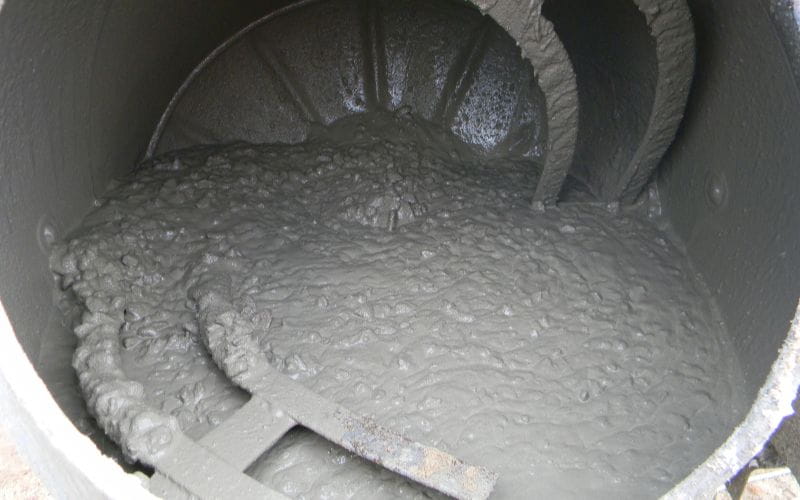
A core component of determining the perfect concrete mix is the level of hydration. Counterintuitively, concrete does not “dry” in a traditional sense but rather cures through chemical reaction. However, if the mixing process is interrupted or uneven, specific crystal structures are unable to form correctly. Every grain of sand and stone needs to be coated in a thick layer of cement paste, utilising the microscopic precision which will determine whether a wall will last a decade or a century.
Power And Portability With BS Power Concrete Mixers
When operating in a South African context, there are a myriad of factors which can pose a challenge to construction equipment, and moreover, concrete mixers. This raises issues such as temperature fluctuations, highly abrasive dust and debris, and more often than not, a need for an independent energy source for remote sites during loadshedding.
It is with this in mind that important decisions need to be made concerning the choice between electric, petrol and diesel mixers so as to best serve the specific construction need.
In the following section, we will provide a brief outline of the different options involved in choosing specific cement mixers.
Electric mixers are generally the preferred choice for urban and residential projects. This is because reliable power sources are available up to 220V. An additional pro to this model is that they require little maintenance and has an easy “plug-and-play” simplicity, which is ideal for smaller construction teams.
Similarly, petrol mixers are viewed as the true workhorse of South African suburbs. Utilising Honda and Baumax engines, these units are able to provide the key aspect of mobility so that they are able to move around sites easily without the need for being tethered to a cable. This offers ease of access for highly demanding and dynamic worksites.
Finally, diesel mixers are the optimal selection for job sites which are heavily industrial-leaning or which conduct agricultural infrastructure. For continuous and heavy loads, diesel concrete mixers are ideal as they provide the high torque necessary for this intensive load-bearing process.
Superior Concrete Mixers: The Anatomy Of Excellence
BS Power’s cement and concrete mixer range can be streamlined into three core components: drum geometry, chassis strength and importantly, the drive system. The first component to consider is the internal drum design. This is where superior engineering comes into play.
Oftentimes, cheaper, more budget-friendly mixers have the issue of a “dead zone” in the centre of the drum. This is an issue as it creates opportunities for materials to clump and therefore affects the overall mixing quality. Contrastingly, more professional-grade mixers are known to feature strategically angled scraper blades. The benefit of this is that they are designed to both lift and fold the material instead of merely spinning it around.
With this precise method, aggregate is mixed thoroughly and adequately aerated so that the mix is workable and ready for application. If you are interested in finding out more about the chemical makeup of cement and how mixing consistency impacts final results, take a look at this resource outlining key areas that need to be considered, such as slump and strength: How Mixer Concrete Performance Affects Slump and Strength (this refers to the flow and workability of concrete).
As a result of the constant vibration which a cement and concrete mixer undergoes as it carries hundreds of kilograms of net weight, a particularly flimsy frame does eventually wear down as the metal buckles and becomes fatigued.
It is therefore strongly recommended to opt for an A-frame design which utilises heavy-duty tow bars. Because South African building sites are often positioned in particularly tough and uneven terrain, it is vital that equipment which needs to move over unpaved terrain is secured adequately with well-engineered wheels and an axle assembly. This is essential as the cement mixer is bound to go through various unpredictable terrains where bumps and scrapes are inevitable.
The last piece of the puzzle is the “power.” Protection of the gears is vital, and thus, the transfer of energy from the engine to the drum should be smooth. To this end, precision-cast ring gears are ideal as they are made from high-quality cast iron. This provides the sought-after durability needed to facilitate the thousands of rotations. A further aspect to consider is the protection of gears from dust and other debris.
The Currency Of Efficiency Concrete Mixers Saving On Time, Labour And Waste
As is the case in any business venture, time is the largest commodity on a job site. As such, securing a reliable concrete mixer means that operations can run more smoothly and timeously, as well as minimising the need and cost of labour.
Replacing the need for multiple hands to shovel and process a single batch of concrete, good cement mixers can produce cement of a far superior quality and in a fraction of the time, while drastically saving on material waste. Added to this, every iota of cement is contained within the drum so that no run-off into the soil occurs. This saves on cost and contributes towards sustainable construction efforts.
To further explore the benefits of using modern cement mixers and how this impacts the environment, consult this resource from the World Green Building Council, which offers a plethora of information on why making sustainable equipment decisions can markedly contribute to a lower carbon footprint in a built-up environment.
The Importance Of Maintenance As The Secret To Decades Of Service
When deciding between which concrete mixers to purchase, a piece of equipment at this scale usually means you are making an investment. As such, having a good management strategy in place cannot be overstated enough to ensure the longevity of your mixer. In the following section, we will provide some tips on how to perform regular maintenance on your mixer for the best protocol on post-use care.
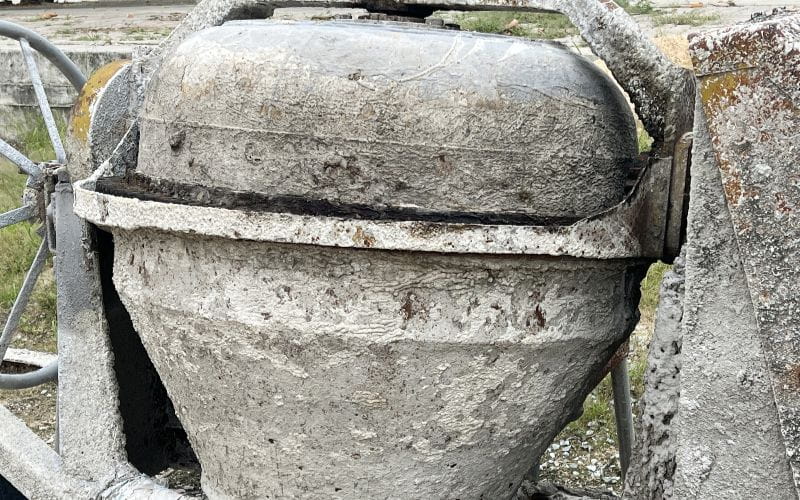
Our number one golden rule is to never allow concrete to remain in the drum after application. While this may be very logical, repeated negligence on this score will result in a buildup which is the true killer of cement mixers. If a layer of dried concrete remains on the drum, it can have multiple knock-on effects, such as unbalancing drum rotation and increasing strain on the engine.
Our second tip is to never underestimate the importance of lubrication. With various moving parts such as the ring and pinions, a fastidious greasing is necessary to allow for smooth operation. This is, unless of course, it specifically states that the engine is a dry-run system.
Not unlike a car, the engine in a cement mixer, which uses petrol and diesel, requires regular oil changes and checks, as well as air filter cleaning. In South Africa, when working on job sites in the Highveld, air filters can easily become clogged in a matter of days. Maintaining and managing a clean engine is truly the best manner in which to ensure the longevity of your cement mixer.
Safety For Your Concrete Mixers
It doesn’t take an expert to know that construction sites are often extremely hazardous places. As such, cement mixers, which contain multiple heavy rotating parts with high-torque engines, require a certain kind of handling. Three core aspects to consider for the safe handling of these mixers are stability, entanglement hazards and ergonomics.
For stability, it is best to ensure that the mixer is on level ground before beginning the mixing process. Uneven terrain can cause the mixer to tip and thus cause major injury or loss of material. Modern mixers provided by trusted suppliers like BS Power ensure that safety guards are installed. On this score, it is important that operators are adequately trained to know what equipment and loose tools, clothing and other potentially hazardous materials should be kept away from the ring gear.
Finally, as far as ergonomics is concerned, the height of the discharge needs to be optimised so that back strain is reduced – especially for individuals who are responsible for catching the cement pour in wheelbarrows.
For further information on how comprehensive workplace safety should be implemented for the use of cement mixers, head over to this resource from the Institution of Occupational Safety and Health (IOSH). This is an invaluable resource on understanding the specific health and safety standards which need to be adhered to in a South African construction context.
Choosing BS Power
If you decide to opt for a BS Power cement mixer, you will be in the company of some of the leading construction companies in South Africa. At BS Power, all our mixers are specifically designed to meet the needs of the local market. As such, we ensure that we have mixers suitable for all our clientele. Whether this is our Karoo farmer out in the bush, or a business developer in Santon, we even have something tailored to the average homeowner completing a DIY project.
Furthermore, all our equipment is designed in such a way that it is easy to repair and maintain. When investing in a cement mixer, we want your investment to last. It’s for this reason that we always ensure that all the spare parts, from replacement drums to engine components, are easily accessible and replaceable.
As such, when you embark on your next construction project, whether a small DIY home project or a commercial warehouse, BS Power’s concrete and cement mixers will give you the brick and mortar of your success. Gone are the days of fatigue caused by hours of labouring on a single batch of cement. Now, at a fraction of the speed, you can produce large, homogenous mixes so that every foundation is structurally sound.