




From the outside, all cement mixers pretty much looks the same: you’ve got your sturdy frame, the spinning drum, and an engine that gently hums away while concrete is churned on the inside. But what truly separates a reliable cement mixer from a money pit is not what you can see at a surface level; it’s the engineering found within the drum.
These are the crucial components that most people overlook: the paddles, bearings, ring gear, and seals, which are the unsung heroes of every pour. These are the parts of the machine that determine just how efficiently your cement blends, how smooth the mixes are, and how long the mixer lasts before an expensive breakdown. And if any of these components fail, your productivity plummets fast.
For the modern contractor working in South Africa, the mix of heat, dust, and humidity requires us to have a fundamental understanding of these inner workings. It can mean the difference between a mixer that lasts five years versus one that dies in two. It all boils down to small habits like greasing your bearings, checking the belt tension, cleaning excess residue, and having the know-how as to when to replace worn-out paddles.
In this BS Power guide, we’re going to break open the heart of the mixer, piece by piece, to show you what actually keeps it running smoothly. We’re going to break down exactly how each part works and functions, what signs of wear to look out for, and how smart maintenance decisions can protect your investment for years to come.
The Mixer Drum: The Beating Heart Of The Machine
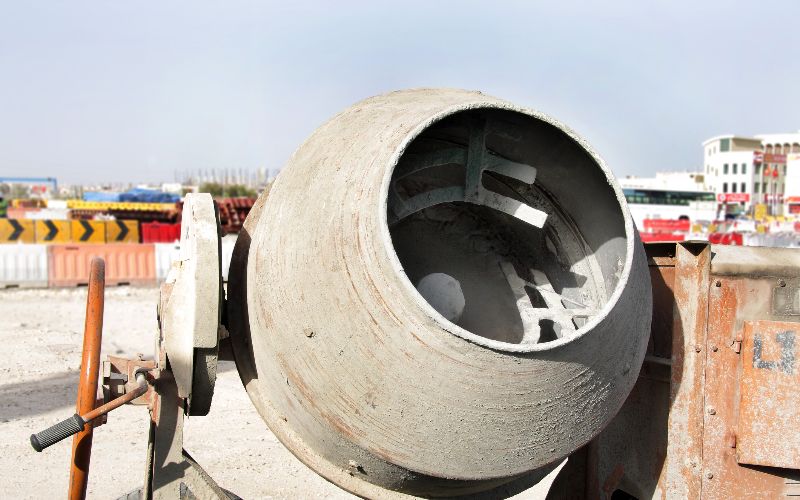
If the engine of cement mixers are the heartbeat of the machine, then the drum is the muscle; it’s there to do the heavy lifting, turning your raw materials into smooth, workable blends. It’s paramount to know that the shape, thickness, and condition of your drum determine everything from the quality of mixers to how fuel-efficient it is, and yet it’s often the most abused part of a mixer.
But Why Does Drum Thickness And Shape Matter?
First thing to note is that a drum’s thickness is not only about durability; in fact, it also affects the balance, vibration, and even mix texture.
For example, cement mixers with thicker steel drums (2/5-3mm) like the ones found on the 400 L Honda and Baumax models are able to resist the formation of dents and deformation, keeping rotation steady even when the mixer is under heavy aggregate loads. On the other hand, cheaper imports commonly use much thinner sheet metal that can flex during the mixing process, which effectively reduces the speed of the drum and your overall job efficiency.
Then there’s shape, which also matters, as a deeper conical design can help lift and fold concrete evenly, while drums that are shallower commonly tend to spin the mix without properly blending it.
All that being said, even a drum that is well-built can take a beating over time from friction, moisture, and trapped slurry. Then there’s micro-pitting, corrosion and dried cement build-up that can slowly change the internal surface, essentially turning smooth steel into a rough, inefficient grinder.
The Mixing Paddles
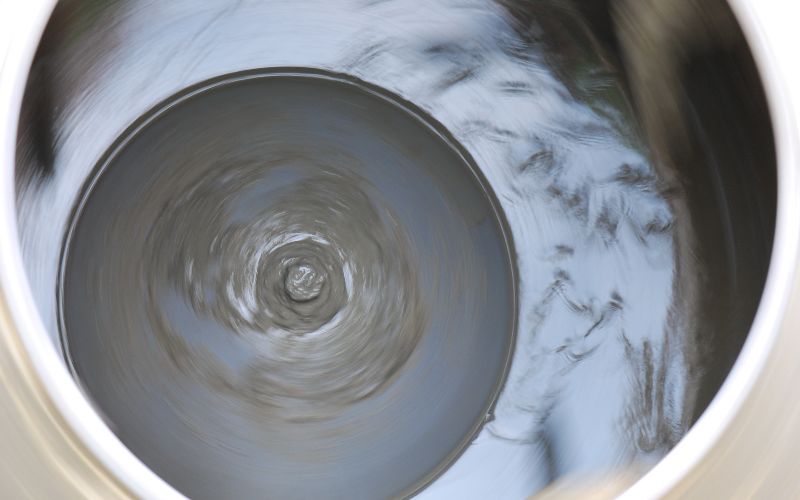
When anyone talks about the innards of a mixer, they rarely give the mixing paddles the credit they deserve. And yet, these small, curved blades inside the drum actually do the mixing by lifting, folding, and circulating the aggregate and cement until every batch has a smooth and consistent texture. Without mixing paddles, even the best drum and engine setup will deliver weak and uneven mixes.
The Paddle Design & Material
One critical aspect is the design and angle of the mixing paddles; a set that is well-calibrated creates a “figure-eight” motion that evenly distributes moisture and stops aggregate from settling at the bottom of the drum. On the other hand, mixing paddles that are poorly designed or worn out will produce dry pockets and inconsistencies in the mix strength.
Several engineering studies have shown that the angle of the mixing blades directly affects uniformity, mixing energy and batch quality. In 2024, a study conducted on mixers uncovered that an inclination of roughly 45° provided the best compromise between power efficiency and particle blending.
The most durable paddles are commonly cast using hardened steel or thick-gauge mild steel, which is designed to withstand abrasion. On the other hand, cheaper models tend to be made using pressed aluminium or thin sheet steel paddles that commonly bend or become misshapen after only a few months of use. But at BS Power, all our cement mixers, including the 400 L Honda GX160 model, feature precision-welded steel paddles that have been developed for torque-heavy performance.
Wear & Tear, Replacement, And Alignment
As is the case with any moving part that encounters stone and cement daily, mixing paddles do eventually wear down. A study conducted in 2025 found that paddle edge wear beyond 3 mm can significantly decrease the uniformity of mixes, and also increase the cycle time.
It is important to regularly inspect your cement mixer paddles for rounded or dulled edges, as these can reduce the lift and mixing effectiveness. Watch out for uneven wear across the paddles and any distortion or bending that could alter the drum flow. Monthly inspections are recommended, with early replacement of any worn paddles to maintain optimal mixing performance.
Keeping the paddles aligned with the drum’s rotation ensures consistent torque transfer, while brushing them clean after each pour is crucial, as hardened cement can quickly lead to corrosion if cleaning is neglected. While the paddles are responsible for effective mixing, the bearings and seals play a vital role in supporting the rotating drum, absorbing vibrations, and protecting the moving parts from water and cement dust, ensuring the mixer operates smoothly and reliably.
But Why Do Bearings Matter?
A cement mixer drum can actually weigh well over 100 kg when it’s loaded, and all of that mass actually rotates on just two bearing housings. These bearings have to be able to handle constant radial load, grit, and show vibration without ever seizing up. If they do fail, the symptoms are easy to spot; you’ll hear loud grinding sounds, uneven rotation, or even notice that the drum refuses to spin at all.
Several industrial studies have confirmed that improper lubrication is the leading cause of premature bearing failure. Many manufacturers have recommended regular relubrication intervals that depend on the operating conditions, typically once a week for dusty, high-load environments, such as construction sites. BS Power Pro Tip: We recommend using a lithium-based multipurpose greaser (NLGI Grade 2) for general conditions and a high-temp variant if you’re going to be continuously mixing under a harsh sun like ours in SA.
The Role of Seals In Cement Mixers
The seals in a cement mixer drum essentially act as a barrier between chaos and order, keeping out contaminants and lubrication. When a seal does fail, cement slurry and grit can enter the housing, which can quickly wear down the bearing surfaces. During field trials, the National Lubricating Grease Institute or NLGI reported that contamination can shorten the lifespan of bearings by as much as 80% in heavy-equipment environments like construction sites.
How can you spot the warning signs? Well, you might notice grease leaking down the frame or there might be cement streaks forming around the housing. You might hear a “clunk” when you start or stop the rotation of the drum.
BS Power’s Routine Care Checklist:
Clean the exterior of the housing after every pour. Conduct weekly greasing or after every 40 hours of operation. Inspect the seals on a monthly basis, and replace if cracked, hardened or leaking.
At BS Power, our cement mixer range all use heavy-duty sealed bearings that have been engineered for harsh conditions on African sites, with all spares being readily available.
Cement Mixers In Stock At BS Power
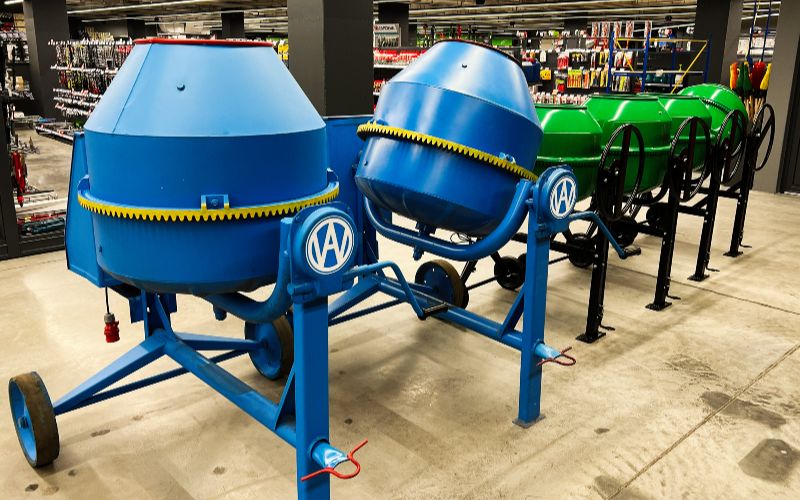
So, when it comes down to putting all this theory you’ve read this far into practice, here at BS Power, our range of cement mixers gives contractors a choice between durability, capacity, and mobility, all designed for use on tough South African job sites. Each of the models we stock is designed around the same principles: heavy-duty components, easy maintenance and value in the long term.
The Honda 360 L Cement Mixer
The 360 L Honda is a compact yet powerful cement mixer, capable of producing around 0.2 m³ of mixed output per batch, which is perfect for small slabs, columns, and general-purpose site work. This engine is world-renowned for its reliability and fuel efficiency, boasting a robot-welded drum, enclosed engine bay, and a reinforced chassis.
The Honda 400 L Cement Mixer
This Honda 400 L cement mixer increases drum volume by 10% and includes a towable wheel kit for larger crews or longer pours. It boasts 3 mm-thick drum walls that can handle coarse aggregate without flexing, and its high-speed pulley system ensures a uniform mix every time, even when under heavy loads.
The Baumax 400 L Cement Mixer
If you’re working on job sites that require serious torque, then the 400 L Baumax cement mixer is ideal, pairing a robust 6.5 hp Baumax engine with a heavy-gauge drum and ring-gear assembly that is found across the range. This cement mixer is built for endurance, extended shifts, rough terrain, and constant batching, and parts and servicing options are available through our national network.
All our stocked cement mixers are made with robot-welded steel drums, precision-machined ring gears, and sealed bearings to ensure consistent performance with every batch mixed. We also provide access to genuine spares and accessories to minimise any downtime.
BS Power: Your Go-To For Cement Mixers
Each and every component that makes up a cement mixer stocked by us at BS Power, from the mixing paddle to the bearings, aligns with a design philosophy that is centred on longevity and real-world reliability. In no way are the cement mixers we stock simply showroom machines; in fact, they are built for the dust, heat, and the workload of construction life here in South Africa. So, if you, or your team, are mixing on job sites daily, you’ll notice the difference between a cheaper import and one of the cement mixers stocked by BS Power: think low vibration, far fewer breakdowns, and smoother, more uniform concrete.
Throw in the fact that we provide access to local servicing, spare parts support and access to the trusted brands that are Honda and Baumax, and you’ll get a machine that keeps paying for itself long after you’ve completed your first project. So, whether you’re pouring concrete for a new patio, laying foundations, or keeping your entire crew in a productive flow, ensure that you choose a mixer that’s designed to last.